


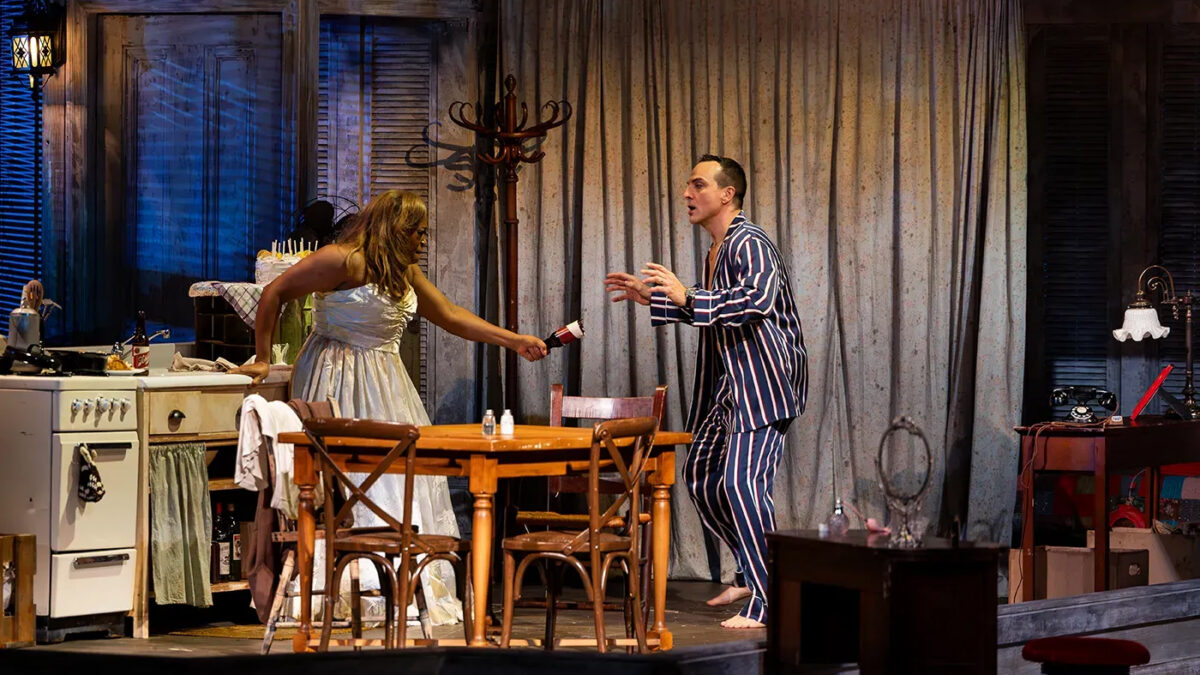
Brittany Renee and David Adam Moore in A Streetcar Named Need at Boston Lyric Opera /Picture: Nile Hawver/Nile Scott Studios
A Streetcar Named Need has come unfastened and is barreling uncontrolled down a observe in the direction of a well-meaning forged of singers and manufacturing workforce. However! You could have a lever that you could pull that may divert the tram onto one other observe the place Tennessee Williams is lashed to the railroad ties. What is going to you do? Depart the creator intact whereas obliterating the potential of an opera, or mangle the playwright on the expense of artists who won’t ever be capable to escape his ghost?
We all know the choice André Previn made when adapting the play for San Francisco Opera in 1998. Tennessee Williams’s most well-known play is dense, lyrical, and rhythmic. At its middle, the southern belle in extremis, Blanche DuBois, plums depths of manipulative self-delusion that rival Nathan Fielder’s latest depiction of Elizabeth Holmes. The enigma of Blanche—an enigma that seeps out from the principle character to paint her complete environment—is in how we are able to each be so totally subjected to the hyperrealistic trivia of an individual’s life whereas on the similar time feeling like we aren’t getting a lot (or most or any) of the true story.
Previn’s rating proves the futility of working inside that slim and stereotypical conception of opera as a ‘turning to music when phrases fail.’ If the phrases are already failing the characters—or working so effectively that they fully obscure them—then what does music have so as to add? Within the case of Previn’s Streetcar, simply three hours of awkward, atmosphere-less languor. As an alternative of perception, we get screeching streetcar noises. As an alternative of atmosphere, we get plodding recitative nudged dutifully alongside by Daniela Candillari‘s conducting.
Thought of, then, on a foundation of effort versus reward, the function of Blanche within the opera turns into a surprisingly thankless one. Brittany Renee threw herself in wholeheartedly, giving a extremely dedicated and really bodily efficiency in an element that has her onstage for about 90% of the opera’s three hours. Her Blanche got here most alive in her moments of reverie, like throughout the best-for-last monologue “I would like magic,” whereas the longer conversational passages (together with Blanche’s overwrought monologue about her first husband and the agonizingly boring seduction scene between her and her suitor, Mitch—definitely extra Previn’s fault than the soprano’s) had been wanting for charisma. Previn ascribes a lot of the lyrical singing in his opera to Blanche’s earnest if put-upon sister Stella (right here a stretched however sympathetic Angela Yam), whereas Blanche has to scrounge round for swigs of legato and appears not simply unmoored from, however fully alien to, the musical realm of her sister.
David Adam Moore, as Stella’s brutish husband, Stanley, whose conflict with Blanche’s papier-mâiché gentility results in Blanche’s breakdown, matched Renée, his singing unflaggingly regular if monochromatic baritone and his presence a bit extra refined than savage. Brenton Ryan as Blanche’s suitor Mitch, a extra genteel foil to Stanley, was charming and sang with a extra weighty tenor than I used to be used to listening to from him. Erika Brookhyser was in brassy voice as Eunice, the no-nonsense upstairs neighbor, whereas David J. Castillo introduced a noteworthy assuredness because the Physician who escorts Blanche to the asylum within the opera’s ultimate scene.
In her manufacturing that first debuted final summer time at Opera Theatre of St. Louis, soprano-turned-director Patricia Racette makes no main interventions into the opera’s wan dramaturgy and her staging strikes cleanly if unspontaneously. Largely confined to a calmly cluttered, elevated platform in the midst of the stage, the characters ambled ceaselessly between the claustrophobic residences two rooms. The manufacturing made a considerably gratuitous use of projections (by Kylee Loera), even throughout the graphically staged rape of Blanche by her brother-in-law. It’s onerous to think about Previn’s music inspiring a director past Williams’s personal copious stage instructions, however the shadowy lighting by Eric Southern proved an evocative contact.
It’s good to see regional American opera corporations lastly working in a coordinated method to convey productions of latest or latest American operas to audiences throughout the nation. (Omar and El último sueño de Frida y Diego are different robust examples.) However in relation to Previn’s Streetcar, it must be time to tug the brakes.

Harry Rose
Harry Rose, based mostly in Windfall, Rhode Island, is at present pursuing a PhD in Italian Research at Brown College. Beginning out running a blog independently as Opera Teen in 2013, he holds the auspicious distinction of being the youngest author to ever contribute to parterre field (at age 14) and has had the pleasure and problem of writing for the rigorously discerning cher public since 2012. More and more area of interest hobbies and pursuits embody opera, ballet, theatrical goings-on of the fin-de-siècle, and gatekeeping Camp.

