

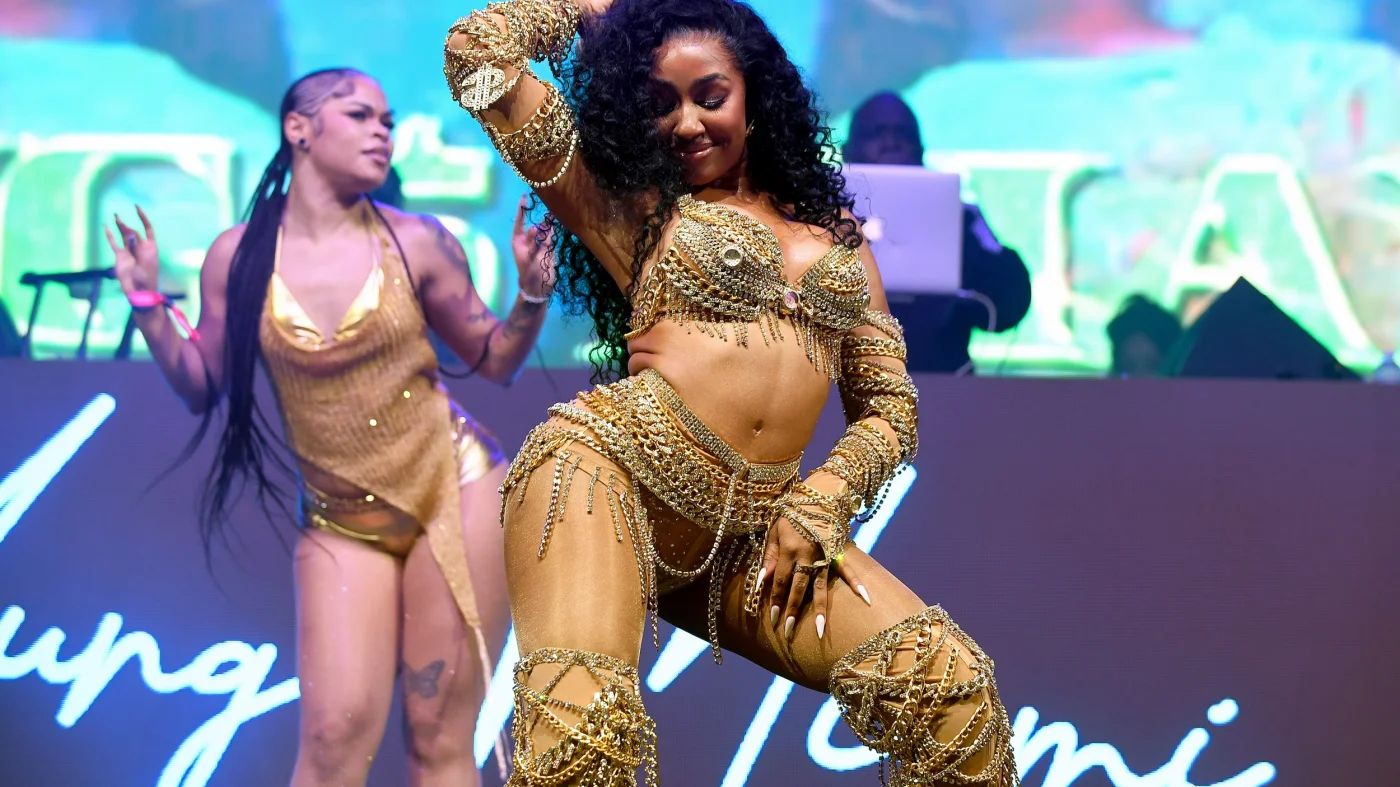

LOS ANGELES, CALIFORNIA – JUNE 27: Yung Miami performs onstage throughout BETX Essential Stage offered by Hyundai through the 2026 BET Expertise Fan Fest at The Beehive on June 27, 2026 in Los Angeles, California.
Aaron J. Thornton/Getty Photographs for BET
conceal caption
Aaron J. Thornton/Getty Photographs for BET
After spending three hours counting the pores on Elizabeth Holmes’ and Nathan Fielder’s faces, I could not assist however suppose how excellent Yung Miami’s “Spend Dat” would’ve performed over the closing credit. No matter you’re feeling concerning the veracity of the protagonist within the blockbuster doc You Can See The whole lot, there isn’t any doubt about her innate capability to cop and blow cash quick. She’s most likely about as accustomed to Diddy’s favourite Metropolis Lady as she is with Abbott & Costello. However a scammer of such sick reputation deserves an apropos theme track. Hell, perhaps all of us do.
When folks complain about hip-hop now not being political, what they’re actually speaking about is business rap’s long-fizzled countercultural agenda. The politics of consumption and corruption nevertheless have by no means loved a louder ringing endorsement. Like a billionaire hogging the bully pulpit. To that finish, no track in 2026 comes nearer to mimicking the sensation of being the violated and the violator. On its face, “Spend Dat” is a get-money flex devoted to all of the “scammers” and “booster b*****s.” However behind that seductive veneer is the sadomasochistic loop of late-stage capitalism’s lengthy, punishing con. An inflation indicator like no different, it is simply our most American anthem of the yr. And we’re all transfixed, nodding alongside in unblinking dedication to the charade.
The video for “Spend Dat” appears like a throwback to the early 2000s, when making it rain in strip golf equipment was nonetheless compulsory signposting for promoting the dream. It virtually feels trite now that prediction markets enable us to position digital bets on democracy and buy-now, pay-later loans hold increasing on our freedom to fall deeper in debt. No less than a great lap dance got here with a tangible return on funding. Now we’re all simply being teased to demise.
YouTube
When India.Arie echoed the general public denouncement of “Spend Dat” — which included a name for Black people to boycott the Billboard-charting track of the summer time — one other movie, I Love Boosters, had simply hit streaming. In contrast to the aforementioned documentary on the blonde-haired, blue-eyed, white-collar scammer Holmes, rapper-turned-director Boots Riley’s fictional narrative centered on the supposed scourge of the hood. In it, Keke Palmer performs an illegit booster, promoting high-end fenced clothes out of the deserted fast-food rooster joint she’s squatting in whereas harboring her personal modern aspirations. It takes a world worker-led intervention — and a sci-fi bopgun filled with Marxist intentions — for her to appreciate the minor disruption she and her shoplifting girlfriends are inflicting is however a needed cog within the ever-churning, exploitative wheel of worldwide capitalism.
What Riley needs us all to know, as an avowed communist who switched his weapon of selection from fronting Bay Space rap group The Coup to writing screenplays, is that we the individuals are hardly the issue. Even when victims flip into self-styled hustlers out of desperation as an alternative of pooling their collective energy. Like WEB DuBois earlier than him, Riley calls his artwork propaganda. And he is equally adamant about calling artwork on the opposite finish of the spectrum of propaganda, too. “When The Coup first got here out they’d name us a political rap group. And we would be like, ‘No,’ ” he stated on a current episode of Novara Media’s podcast Downstream. “Do not name us that except you are calling everyone that. As a result of what it then made it look like was as if every little thing else was simply what it’s.” Slightly, artwork magnifying the established order is just not some benign illustration of a set actuality however an uncritical regurgitation of every little thing indoctrinated by the moneyed elite.
When the controversy surrounding “Spend Dat” reached a fever pitch earlier this summer time, it got here with the same old diatribe. The track was criticized for being culturally degrading. Even India.Arie caught a bunch of flak for stating the apparent when she stated, “The whole lot you hearken to see or eat goes to affect you.” I do not blame anyone Black for getting of their emotions over the seemingly unfavorable portrayals or stereotypical depiction centered in rap. However the buck does not cease there. It by no means has. “We’re certain by all types of customs which have come down as second-hand soul garments of white patrons,” as DuBois so eloquently said 100 years in the past this month in his essay Standards of Negro Artwork. “We’re ashamed of intercourse and we decrease our eyes when folks will speak of it,” he says, concluding with this thought: “Our worst aspect has been so shamelessly emphasised that we’re denying we’ve got or ever had a worst aspect.”
YouTube
The identical week “Spend Dat” went platinum, Yung Miami appeared on “The Breakfast Membership” to advertise the discharge of her solo debut, Watch Dis. When requested concerning the criticism the track obtained, she defended it as inspirational music “that builds you as much as need to be someone.” Rap could have began on the backside. However in some unspecified time in the future the script flipped. The programs hip-hop was oriented to insurgent towards grew to become the metric for its success. The victors, on this case, had been discovered striving for a similar spoils. Having lastly achieved the market share and visibility we would been denied for many years, we grew to become centrists: a marginalized tradition subsumed by the mainstream. Industrial rap made itself a great tool of the institution, and the right racially coded scapegoat.
If the American Dream actually is a pyramid scheme, as generally critiqued, all hail the unique scammers who bricked up the muse. Even with their fuzzy slave-owner math (discounting Blacks as three-fifths human) and gender restrictions on equal rights (ratified whereas rocking powdered wigs), the nation’s so-called founders created a system even the bottom caste could possibly be constrained and cajoled into aspiring to.
It jogs my memory of the funniest meme I encountered on-line final week: a comic book strip calling cap on the promise of Black capitalism. It photos two brothers chopping it up, with one plainly stating, “You’ll be able to’t purchase your manner out of a system that was constructed on promoting you.” Completely undeterred, the opposite replies again, “Nicely, I am gonna strive!” earlier than invoking the Black energy period’s “by any means needed” rhetoric. Within the subsequent panel, Malcolm X expresses frustration over his phrases being misused to validate participation within the futile American experiment.
We have been hoodwinked, certainly. Bamboozled. Led astray. Run amok and flat-out deceived like a mug.
The grift is so full that it is virtually unimaginable to tell apart the mark from the precise con artist. Whether or not it is a convicted felon hiding fraudulence behind white tears, or a ride-or-die who bossed up with the boosters and obtained it off the muscle. In a yr when prediction markets and predatory installment loans sucked us all dry, inflation skyrocketed and tech billionaires quickened the apocalypse, an ode to America’s timeless hustle and stream is perhaps the closing credit theme all of us deserve.

