


 United States Janáček, Jenůfa: Soloists, Refrain and Orchestra of the Metropolitan Opera / Tomáš Hanus (conductor). Metropolitan Opera Home, New York, 23.11.2026. (ES-S)
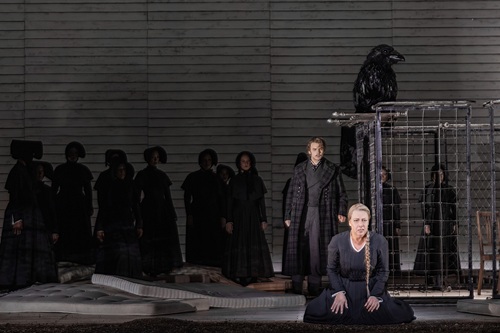
In Leoš Janáček’s Jenůfa, probably the most horrible act is born of a tragic entanglement of maternal love and self-interest. Satisfied that she is defending her stepdaughter from public shame, the Kostelnička in the end sacrifices an harmless life to protect her personal standing locally. It’s this oppressive energy of communal judgment that Claus Guth locations on the heart of his interpretation.
First staged 5 years in the past at London’s Royal Opera Home, Guth’s manufacturing has now arrived on the a lot bigger Metropolitan Opera. But the switch is remarkably profitable. From the orchestra seats, the principal singers might be heard clearly, their positioning close to the entrance of the stage serving to to beat the corridor’s huge dimensions. A curtain of black latticework, resembling the barred entrance to a jail cell, rises to disclose Michael Levine’s stark setting. Towering, windowless white partitions appear to shut in on the occupants, dwarfing the rows of beds and chairs set out in inflexible order. Black-clad village ladies have interaction in routine duties – peeling potatoes and arranging chairs and sheets – whereas Teresa Rotemberg’s choreography alternates regimented collective actions with the extra exuberant dancing that accompanies Števa’s arrival. Sudden, angular gestures echo the jagged rhythms and insistent repetitions of Janáček’s rating.
Within the second act, order provides solution to disarray. Guth’s staging turns into more and more expressionist, its black-and-white imagery evoking the work of William Kentridge. The ladies, sporting black bonnets, transfer as a mass earlier than taking their seats going through the again wall. Some ultimately try to climb it, like bugs or darkish ideas struggling to flee. The mattresses now lie scattered throughout the ground, overlapping like damaged sheets of ice beneath which the toddler’s physique shall be hid. The Kostelnička’s home, a lattice-like cell, casts shadows that reach nightmarishly throughout the backdrop, blurring the boundary between bodily imprisonment and inside torment. Significantly haunting is a determine in a protracted black gown with an infinite raven’s head. It scales the surface of the home, perches above it and later prowls behind it. A standard harbinger of loss of life, the raven appears to embody her mounting dread, anticipating the guilt that can observe her crime.
In Act III, James Farncombe’s hotter lighting suggests the arrival of spring, whereas yellow flowers carpeting the ground present the primary substantial burst of shade. The black clothes of the marriage visitors, designed by Gesine Völlm, are embroidered with diversified, brightly coloured folkloric motifs. The partitions, nonetheless, stay unchanged. Jenůfa’s plain black mourning costume casts doubt on that promise of renewal. Information that the frozen toddler has been discovered shatters the celebration. The villagers converge on Jenůfa, forming a hostile human wall, till Laca intervenes. Guth levels the confrontation with restraint, permitting Janáček’s music to drive the scene.
Asmik Grigorian’s Jenůfa and Nina Stemme’s Kostelnička anchor the efficiency. Grigorian, who additionally sang the position in Guth’s unique London manufacturing, is an exceptionally clever singing actress whose refined gestures and reactions to these round her reveal the depth of her identification with Jenůfa. Her singing is equally compelling, significantly within the second-act prayer the place finely shaded phrasing and a wealth of vocal nuances convey vulnerability with out sacrificing inside power.
Stemme establishes the Kostelnička’s unyielding resolve when she forbids Jenůfa’s marriage to Števa till he has remained sober for a yr. Her severity is rooted in reminiscences of life with an abusive alcoholic husband; a destiny she hopes to spare her stepdaughter. Though her higher register has misplaced a few of its former steadiness, Stemme transcends this limitation by means of eloquent supply and dramatic conviction. Affecting in Act II, she is much more highly effective in Act III, as her self-possession dissolves into nearly frenzied agitation. Jenůfa, in the meantime, steadily emerges from her preliminary devastation to answer her stepmother with extraordinary calm and forgiveness. Solely then does the Kostelnička acknowledge that she cherished herself greater than her stepdaughter. The lady who as soon as claimed the authority to find out Jenůfa’s destiny now stands earlier than her in determined want of absolution.
Sean Panikkar delivered a riveting portrayal of Laca, Jenůfa’s jealous suitor, matching Grigorian’s fierce dedication. His perceptive appearing captured Laca’s obsessive love for Jenůfa and his bitter resentment of his half-brother Števa, which erupts in a violent assault that disfigures Jenůfa. Panikkar additionally revealed a tenderness beneath Laca’s aggression, making his eventual selfless devotion to Jenůfa solely plausible. His tenor had a penetrating edge, but he may summon outstanding delicacy when the music demanded it. All of the extra spectacular, then, that he made his position debut after solely weeks of preparation. Ryan Capozzo was convincing as Števa, capturing each his cocky self-assurance and his underlying cowardice. The supporting forged and Metropolitan Opera Refrain carried out admirably.
Below Tomáš Hanus, the Metropolitan Opera Orchestra introduced out the richness of Janáček’s rating, from its driving momentum to passages of surprising lyricism. Born in Brno and steeped within the composer’s operas, he demonstrated an instinctive understanding of their speech-inspired musical language, eliciting rhythmically incisive enjoying. By comparability, the principal singers, none of them native Czech audio system, articulated the textual content with care however usually missed the pure cadence, refined shifts of emphasis and conversational spontaneity that distinguish Janáček’s vocal writing.
Within the last moments of Guth’s staging, Jenůfa and Laca step in entrance of the descending black latticed curtain. For the primary time, the barrier that has confined them stands behind them. But whether or not they can ever free themselves from the previous stays unsure.
Edward Sava-Segal
Featured Picture: Asmik Grigorian (Jenůfa) in Janáček’s Jenůfa © Evan Zimmerman / Met Opera
Manufacturing:
Director – Claus Guth
Units – Michael Levine
Costumes – Gesine Völlm
Lighting – James Farncombe
Choreographer – Teresa Rotemberg
Video – rocafilm
Dramaturg – Yvonne Gebauer
C. Graham Berwind III Refrain Director – Tilman Michael
Solid:
Jenůfa – Asmik Grigorian
Grandmother Buryjovka – Elena Zaremba
Laca Klemeň – Sean Panikkar
Jana – Jazmine Saunders
Foreman of the mill – Roland Wooden
Kostelnička Buryjovka – Nina Stemme
Števa Buryja – Ryan Capozzo
Barena – Cadie J. Bryan
Shepherdess – Sophia Baete
Mayor – Kevin Quick
Mayor’s Spouse – Eve Gigliotti
Karolka – Erica Petrocelli
Aunt – Edyta Kulczak

