


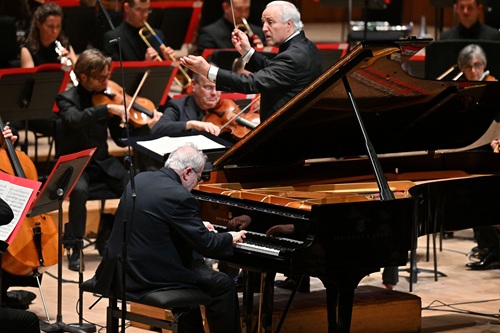
 United Kingdom J. Strauss II, Mozart, R. Strauss: Emanuel Ax (piano) / Philharmonia Orchestra, Manfred Honeck (conductor). Royal Competition Corridor, London. 12.11.2026. (AV-E)
J. Strauss II – Overture, Die Fledermaus
Mozart – Piano Concerto No.25, Ok.503
R. Strauss – Elektra Suite (arr. Honeck & Ille)
Johann Strauss II’s Die Fledermaus Overture opened the night, Manfred Honeck drawing out the music’s heady mixture of class and élan. The waltz melodies had been formed with a graded grace, whereas crisp accents and teasing rhythmic twists gave it a capricious, champagne-cork-popping character and sawing, springy swagger. The Philharmonia Orchestra performed with exuberance and assurance: svelte strings, winsome winds, brazen brass and perforating percussion.
Emanuel Ax’s assured account of Mozart’s Piano Concerto No.25 in C main, Ok.503, was a efficiency of poetic poise and crystalline readability. The enjoying had a pure, direct simplicity, permitting the music to talk for itself, with each phrase naturally nurtured and angelically articulated. Within the opening Allegro maestoso, the imposing orchestral introduction established the motion’s breadth earlier than Ax entered with a readability that by no means obscured its grandeur. The pellucid piano tone remained clearly audible towards the total weight of the orchestra, even within the tuttis, with out Ax ever needing to drive the sound. The supple strings offered a finely managed basis, whereas the woodwind had been incisively built-in into the orchestral texture. The exchanges between soloist and orchestra had been congenially conversational, every answering the opposite with a naturalness that mirrored Ax and Honeck’s radar-radiant rapport.
The timpani made a very putting impression, their hard-stick strokes crisp and emphatic, giving the orchestral tuttis a agency rhythmic edge.
The Andante revealed the quiet eloquence of Ax’s limpid, liquid enjoying. The piano’s long-breathed cantabile phrases unfolded with unaffected tenderness, whereas Ax watched the woodwind gamers attentively, listening and responding to the delicate inflections of their particular person voices. Their delicate exchanges lent the motion an beautiful exhalation.
Within the Allegretto, Ax gave the recurring rondo theme an irrepressible lightness, its quicksilver turns and decorative prospers dispatched with easy fluency. Honeck stored the dialogue between soloist and orchestra sparklingly buoyant, the exchanges alive with wit and rhythmic élan, earlier than the concerto swept to an exhilarating shut. Ax’s easy ease bespoke a consummate command of the sinuous rating.
For an encore, Ax supplied Liszt’s association of Schubert’s ‘Ständchen’ from the Schwanengesang song-cycle (D.957), its moonlit melody unfurling and undulating in emerald evanescences of sapphire sounds, with a young translucent limestone lyricism, reverentially obtained by the adulatory viewers.
‘The color of blood’ was how one critic described the rating of Richard Strauss’s 1909 opera Elektra, which tonight was distilled from 100 minutes to 33 in an orchestral suite-cum-symphonic poem by Austrian conductor Manfred Honeck and his long-time collaborator Tomáš Ille.
Honeck defined on BBC Radio 3 why he wished to deliver the suite into the live performance corridor: ‘I performed myself the Elektra, a number of instances within the Vienna State Opera, for instance, beneath the baton of Lorin Maazel and Claudio Abbado, and I need to say I cherished it. It’s like a film, a musical film, I might say, and I wished this piece additionally to be performed within the live performance home; that’s the explanation why I did it. It didn’t exist but, this symphonic poem, this model by Richard Strauss. For my opinion it’s such nice music I don’t wish to miss this within the live performance corridor. It might have been no sense to do one other Rosenkavalier Suite, as a result of it already exists, however for an Elektra, probably the most, in my view, orchestral opera, I used to be truly astonished why it’s not present, the symphonic poem.’
Certainly, the Elektra Suite seemed like a film soundtrack — and I imply this as a praise, not a criticism — usually reminding me of Bernard Herrmann’s movie rating for Hitchcock’s Psycho.
The symphonic suite made a curious miscalculation proper from the beginning. Honeck’s personal notes draw consideration to the opening’s two statements of Agamemnon’s motif, echoing the opera’s opening gesture. But on this efficiency the repeated proclamation sounded laboured and ponderous, weakening fairly than reinforcing its dramatic influence. It merely didn’t work. The Philharmonia’s brass gave the proclamations great authority, with an exciting chew to the assault and a wonderfully burnished tone; the fault lay not within the enjoying, however within the impact of the repetition.
The recurring motifs give the Elektra Suite a level of thematic coherence, however they don’t make its episodes stream naturally into each other. As an alternative, the music strikes by way of a succession of sharply demarcated blocks, sounding nearly like a cut-and-paste development. After the opening statements of Agamemnon’s theme, it progresses by way of Elektra’s lament and revenge music to Chrysothemis’s lyrical episode and Elektra’s triumphant dance. But these sections too usually appear merely positioned facet by facet. The reduce from Clytemnestra’s nightmare-haunted encounter with Elektra to the queen’s jubilant response to the false information of Orest’s demise is one obvious instance; the sudden insertion of the colorful interlude accompanying Clytemnestra’s retinue equally interrupts the darkish, brooding music heralding Orest’s arrival. Extra basically, the rearrangement locations Clytemnestra’s homicide earlier than the popularity scene, in order that the jubilant horns and timpani saying Orest arrive after the occasion they need to assist to organize. The return of Agamemnon’s theme on the finish provides the suite a cyclical body, however can’t compensate for the abrupt joins and dislocated dramatic sequence inside it.
The suite’s episodic segmentation stays its central weak spot. The rearrangement of the opera’s chronology additional unsettles the dramatic development, disrupting the important ahead momentum Strauss sustains throughout the unique rating. By comparability, Artur Rodziński’s Der Rosenkavalier Suite and Erich Leinsdorf’s Die Frau ohne Schatten Suite are extra persuasive diversifications, their episodes unfolding with higher continuity and much much less abruptness.
Honeck introduced a brooding depth to Elektra’s lonely lament, permitting the strings to maintain its grief-laden phrases whereas the woodwind colored the music with plaintive inflections. The king-revenge and father-love motifs had been sharply differentiated, their contrasting violence and tenderness clearly introduced out by the orchestra. Chrysothemis’s craving music was fantastically formed, the strings and woodwind bringing heat and delicacy earlier than the dance-like writing gathered exuberant momentum. Its attacca transition into Elektra’s triumphant dance was one of many suite’s few totally pure joins, the music seeming to develop out of what preceded it. That sense of continuity, nonetheless, was short-lived. The abrupt reduce from Clytemnestra’s nightmare-haunted encounter along with her daughter, with its dissonant unease and snarling brass, to the queen’s jubilant response to the false information of Orest’s demise was notably jarring. The menace had scarcely taken maintain earlier than the music veered elsewhere; the dramatic pressure was merely deserted.
The identical cut-and-pasted transitions dogged Orest’s look. The darkish, brooding writing within the decrease strings and bassoons started to ascertain an environment of thriller, solely to be interrupted by the sudden eruption of the colorful interlude accompanying Clytemnestra’s retinue. The Philharmonia relished its orchestral bravura, however the insertion broke the thread simply as Orest’s presence was starting to exert its pull. Extra damagingly, the suite locations Clytemnestra’s homicide earlier than the popularity between Orest and Elektra, reversing the opera’s dramatic order. The jubilant horn and timpani of the popularity scene due to this fact got here after the homicide, disadvantaged of their correct dramatic operate. The orchestra performed the scene with great fervour, capturing Elektra’s pleasure in a terrific surge of sound, however the rearrangement had already undermined the second’s dramatic weight. Aegisth’s homicide introduced one more abrupt change of scene. Repeatedly, the music appeared poised to assemble drive, solely to be reduce brief. The recurring motifs offered thematic hyperlinks however couldn’t restore the dramatic continuity the rearrangement had fractured.
The symphonic suite’s tragic conclusion was delivered by three laborious, ferocious percussion blows. The decapitating sensation was exhilaratingly annihilating: the aghast viewers was momentarily marooned and shocked earlier than erupting in ecstatic applause.
Fortunately, the Philharmonia Orchestra has simply introduced the appointment of the consummate and commanding Manfred Honeck as its subsequent Principal Conductor, starting in September 2028.
I listened again to the Elektra Suite on BBC Radio 3’s ‘In Live performance’ rebroadcast, and the sound high quality was completely appalling. The dynamic vary was severely diminished, the climaxes smudged and the orchestral element misplaced. Strauss’s scintillating rating was lowered to mushy muzak, its violent and visceral influence incinerated. At 320 kbps, the printed sound was very closely compressed in contrast with a CD or high-resolution sound. The printed’s constricted sound was a negation of the music itself, an act of sonic vandalism. Strauss would have ‘performed his nut’, as they are saying.
Alexander Verney-Elliott

