


Photograph: Erich Schlegel
Is Thaïs the agent of her personal salvation, or is she merely an object outlined by Athanaël’s spiritual and sexual wishes? What, in flip, can modern audiences be taught from Massenet’s Thaïs, one of many best-known works within the nineteenth-century French operatic repertoire?
Thaïs may be very a lot a product of its time, embodying not solely the nineteenth-century opposition between spiritual devotion and secular need but in addition the interval’s fascination with exoticism. Its central battle emerges by way of Athanaël, a monk decided to guide Thaïs, a courtesan within the corrupt metropolis of Alexandria, to Christ. But beneath his aspiration to save lots of her lies a secular need of his personal: the want to possess her by separating her from different males.
The strain between spiritual conviction and earthly need can also be articulated by way of recurring musical motifs. Within the Act I scene “Qui te fait si sévère?”, Thaïs teases Athanaël with a melody related to what the 1894 assessment in La Liberté identifies because the “theme of the imaginative and prescient.” When a picture of Thaïs reappears in Athanaël’s dream in Act III, the return of this motif intensifies his eager for her. The well-known “Méditation,” heard after Athanaël has preached salvation to Thaïs and promised to attend for her, likewise takes on a recurring thematic operate. Its reappearances as Thaïs approaches the convent of Mère Albine and, finally, as she dies and turns towards God in heaven recommend the contrasting trajectories of the 2 protagonists. By means of these musical returns, the opera vividly phases the competing values and aspirations that formed its historic second.
But audiences are prone to anticipate greater than a interval piece when encountering Thaïs in a recent manufacturing. Introduced as a part of Austin Opera’s Opera Unleashed sequence, which expands the corporate’s repertoire with celebrated works new to its stage, this concert-and-projection manufacturing provided a chance to rethink the opera’s relevance in the present day. In partnership with Spoleto Pageant USA, Austin Opera introduced collectively soprano Nicole Heaston and baritone Troy Cook dinner for his or her third time performing as Thaïs and Athanaël, following productions at Utah Opera in 2024 and Spoleto Pageant USA in 2025.
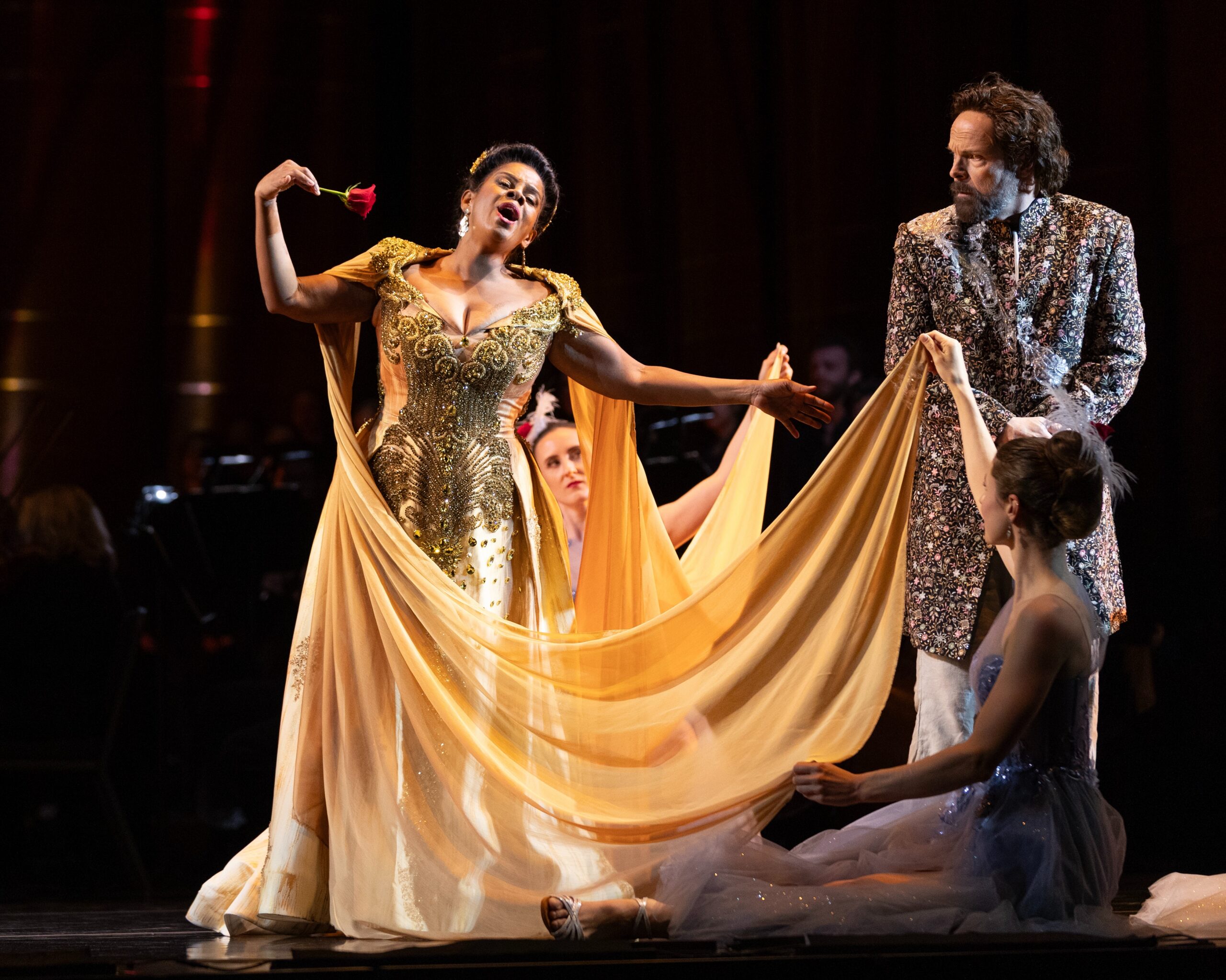
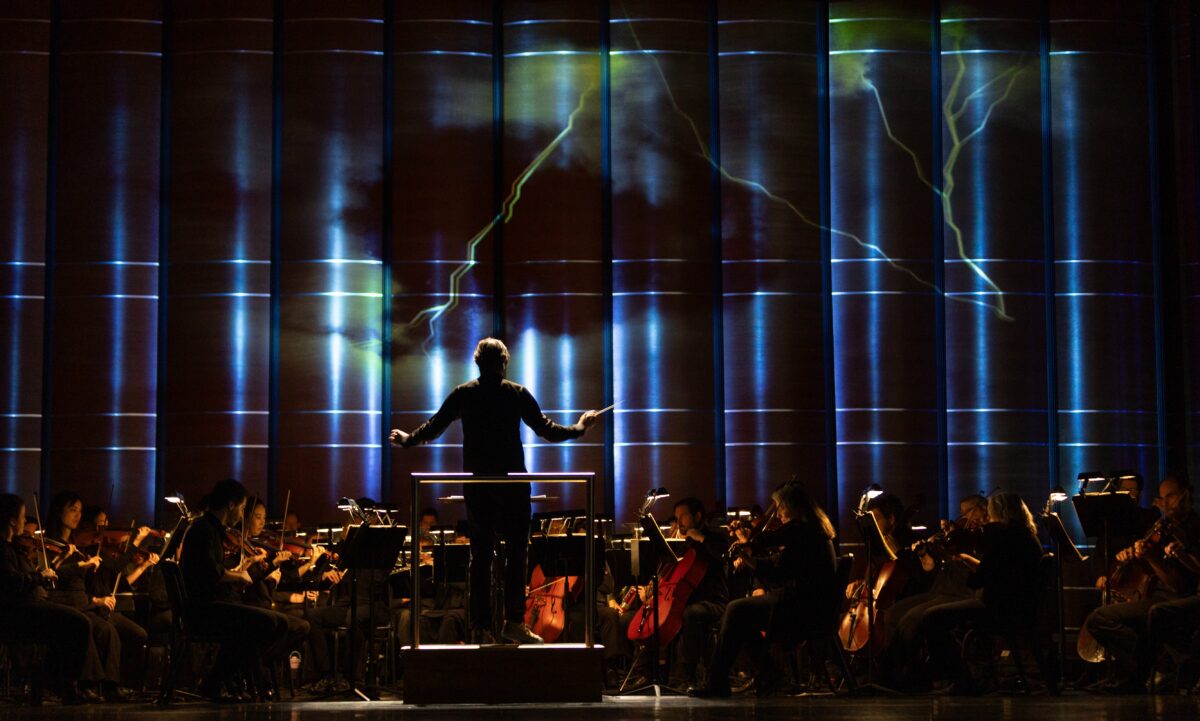
Though audiences anticipating Thaïs’s grand entrance earlier than a crowd of admirers or the frilly, unique festivities at Nicias’s home might need been disillusioned by the absence of conventional operatic spectacle, the minimalist, projection-driven manufacturing by director Crystal Manich, conductor Timothy Myers, and projection designer Greg Emetaz provided a unique type of theatrical expertise. Reasonably than merely recreating the world of the opera, the manufacturing used Thaïs’s story to boost questions on human nature and the methods we perceive ourselves.
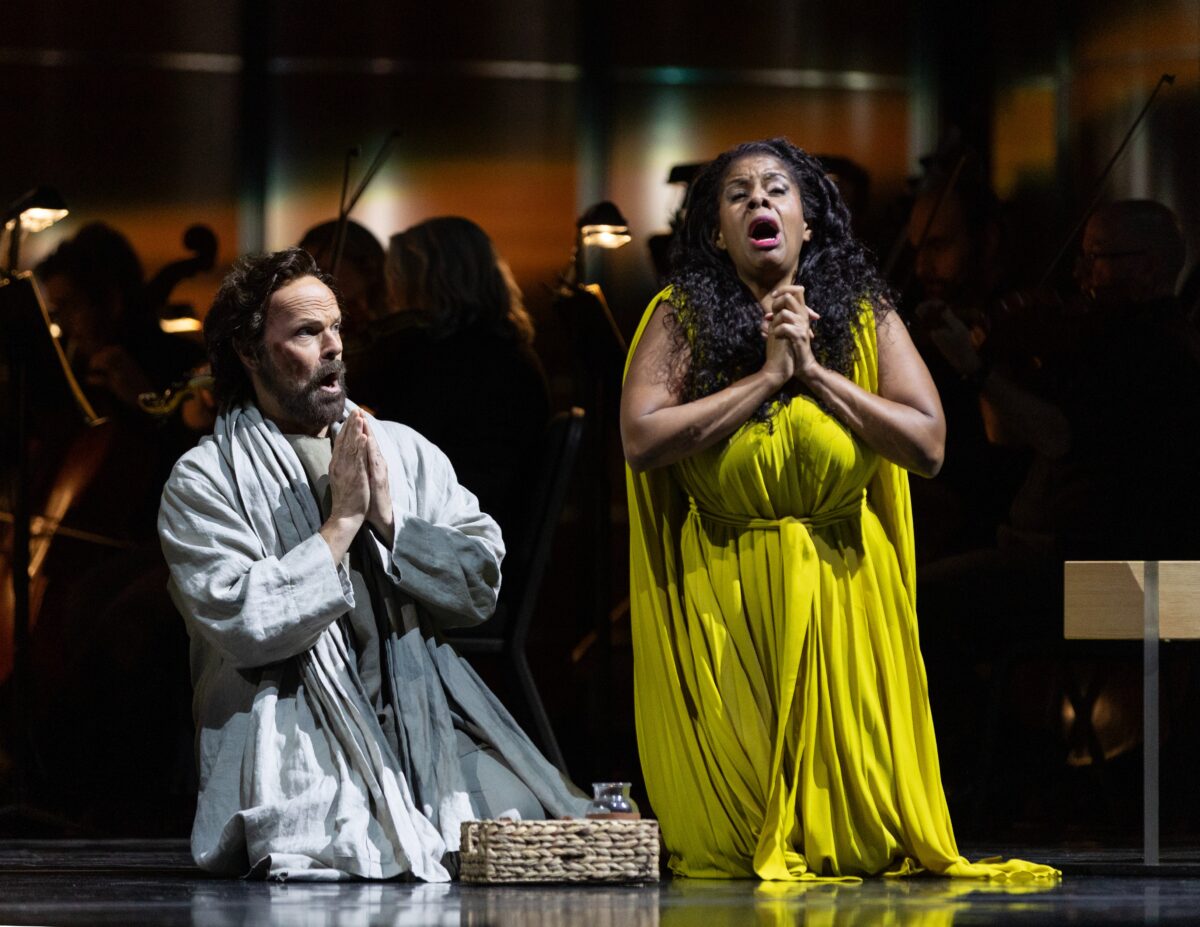
The manufacturing’s central interpretive considerations got here to a head throughout the “Méditation.” Productions have approached it in strikingly alternative ways. In Stefano Poda’s 2008 manufacturing for Teatro Regio di Torino, starring Barbara Frittoli and Lado Ataneli, slow-motion motion emphasised Thaïs’s strategy of non secular awakening. Within the Metropolitan Opera’s 2008 manufacturing, starring Renée Fleming and Thomas Hampson, the curtain remained closed, directing the viewers’s consideration totally towards the violin solo. Manich and Emetaz took one other strategy: Athanaël sat on the ground together with his eyes closed, remaining in a meditative pose all through the opening and shutting passages of the piece. Behind him, projections confirmed a succession of Thaïs’s expressions, starting from her immersion in worldly pleasure to the vacancy beneath it, and at last to her contemplation of the liberty that comes from selecting her personal future. This sequence difficult the acquainted interpretation of Thaïs as a courtesan who merely relinquishes her fame and wealth in alternate for everlasting magnificence. It additionally invited us to surprise what Athanaël may be pondering as he waits outdoors her home. Is his vigil a type of self-discipline, an try to persuade himself that he’s appearing out of non secular conviction reasonably than indulging his personal need to separate Thaïs from different males by making her the bride of Christ? The questions raised by this scene resonate with Myers’s description of Thaïs as “a piece of outstanding emotional complexity that challenges us to rethink the gap between who we imagine ourselves to be and who we really are.”
Photograph: Erich Schlegel
Heaston made her Austin Opera debut within the function of Thaïs. Her interpretation was not a courtesan whose seductive energy relied on overt shows of sensuality. As an alternative, she conveyed her appeal by way of a brilliant, playful disposition and an ease of gesture. In her first encounter with Athanaël in Act I, throughout “Qui te fait si sévère?”, her voice was clear and candy, with excessive notes that captured the ear effortlessly. The mirror aria, in contrast, revealed the vacancy beneath Thaïs’s pursuit of everlasting magnificence. From the opening phrases, Heaston shifted to a barely darker timbre, making a placing distinction with the previous scene. Having returned to her non-public room and the solitude of her mirror, Thaïs is now not surrounded by the numerous admirers who rejoice her magnificence. Heaston made this transition palpable, permitting the viewers to listen to a girl confronting not solely the transience of her bodily look but in addition the void inside. Her characterization finally instructed that Thaïs had arrived at her choice about salvation by way of a strategy of reflection and private wrestle.
Cook dinner’s Athanaël traced a dramatic emotional arc, shifting from the assured monk who boldly seeks to cleanse Thaïs of her sins and return her to Christ to a person who discovers his personal bodily need for her. His closing realization culminates in a determined outburst as he rushes towards the dying Thaïs. In “Voilà donc la horrible cité!”, his response to deprave Alexandria was much less one in every of anger or contempt than of confidence in his personal means to deliver town to salvation. Cook dinner’s brilliant, highly effective vocal tone conveyed this sense of conviction. Equally, in “Étranger, te voilà, comme tu l’avais dit,” the place Athanaël once more urges Thaïs towards salvation after the mirror aria, Cook dinner prevented extreme dramatization at the same time as Athanaël struggled to restrain his need. This restraint made his spiritual mission appear all of the extra resolute. However as soon as he learns that Thaïs is dying, his vocal expression modifications dramatically. His cries of anguish reveal the ache of recognizing his personal need, and Cook dinner made Athanaël’s psychological and non secular collapse a compelling theatrical occasion.
As Nicias, Dominick Valdés Chenes supplied welcome comedian aid in a drama that grows more and more tragic. His gentle but supple voice, sometimes sharpened with the pointed supply of a witty apart, suited the character’s playful temperament. He additionally displayed the vocal richness, stage presence, and pure aptitude of an entertainer. One notably placing second got here on the finish of the scene wherein Athanaël declares that Thaïs has turn out to be the bride of Christ and leads her away. An enormous picture of flames appeared within the projections, and Nicias knelt earlier than it. His posture could possibly be learn as a tribute to the golden age of secular pleasure that was now disappearing, a picture of the dying of the Thaïs he had recognized in a type of hell, or perhaps a foreshadowing of the distinction with Thaïs’s eventual dying and ascent to heaven. The second instructed that Nicias, regardless of his largely comedian characterization, might increase questions that reach past his function as a supply of amusement.
The choreography by Michael Pappalardo was notably efficient throughout the dance at Nicias’s celebration, the place exoticized music accompanies the festivities. Reasonably than trying to breed a dance from an imagined overseas tradition, the choreography foregrounded its personal theatrical development. The costumes strongly evoked belly-dance apparel, whereas the motion remained unmistakably rooted in ballet. This mixture provided an unusually candid reflection of the opera’s personal exoticizing aesthetic. Yuxin Liu, as La Charmeuse, additionally made probably the most of her transient look, delivering her brief however placing melodic passage with seductive aptitude.
Photograph: Erich Schlegel
One facet of the manufacturing, nonetheless, was much less profitable. In Act III, as a storm breaks out and Athanaël rushes towards the dying Thaïs, the lighting results have been designed to amplify the projected pictures of waves and lightning. A number of intense lights flashed in alternating patterns, however their repetition grew to become distracting. The orchestra and Myers had already created an exceptionally dramatic musical second, but the lighting appeared to flatten reasonably than intensify its impact. At this level, I needed the manufacturing had trusted the music and allowed the viewers extra space to hear.
Austin Opera’s Thaïs provided an event to mirror on the worth of selfhood and the liberty to make one’s personal decisions. By foregrounding the psychological complexities of its two protagonists, the manufacturing invited us to query not solely Thaïs’s path to salvation but in addition Athanaël’s motives in searching for it for her. I look ahead to seeing what different works Opera Unleashed will deliver to the stage—and what additional questions on our humanity they could encourage.

Seokyoung Kim
Seokyoung Kim is an unbiased scholar based mostly in Austin, Texas. She acquired her PhD in musicology from the College of Texas at Austin in 2026. Her analysis pursuits embrace opera research, modern music, East Asian and Asian American music, and music criticism. Her dissertation, “Opera, Interculturality, and Asian American Voices in Huang Ruo’s M. Butterfly (2022),” examines Huang Ruo’s adaptation of Puccini’s Madama Butterfly, exploring interculturality and the illustration of racial and cultural minorities in modern opera. Her analysis has been supported by grants from the American Musicological Society and the Virgil Thomson Fellowship from the Society for American Music.

