


Picture: Monika Rittershaus
Richard Wagner developed his Der Ring des Nibelungen tetralogy in reverse, beginning in 1848 with the libretto for “Siegfried’s Dying” (renamed Götterdämmerung). The second day of the Bühnenfestpiel and third half general, Siegfried was initially titled “Younger Siegfried.” Tobias Kratzer’s newest installment on the Bayerische Staatsoper took the unique title actually: The opera is a coming-of-age story from a baby with fantastical creativeness to a naïve however fearless warrior.
With Siegfried, Kratzer and dramaturges Bettina Bartz and Olaf Roth took their interventions within the characters’ interpersonal relationships and biographies a lot additional. Mixed with its progressive and recent casting, these distinctive options proceed to show that this is without doubt one of the most fun Ring cycles in recent times, if not a long time.
Every a part of the tetralogy has centered on an interconnected throughline in Wagner’s epic. Faith in Das Rheingold, unfulfilled romantic love in Die Strollüre, and now the connection between youngsters and oldsters. This can be a lot to tie collectively, however Kratzer and assistant director Matthias Piro pushed the drama ahead at full throttle. The spiritual posters from Rheingold of Wotan’s glory at the moment are pale and ignored. Solely curbside prophets reward the gods, ignored like Boris Godunov’s Holy Idiot. Siegfried additionally yearns for romantic love, however his relationship along with his aunt Brünnhilde is extra grounded in his maternal longing and her position as caretaker slightly than a recurrence of his mother and father Siegmund and Sieglinde’s incest.
This Ring continues its misleading adherence to Wagner’s extravagant imaginative and prescient on stage. Kratzer performed up the fantastical components: gods and mortals work together by means of pyrotechnics and fashionable expertise, Brünnhilde’s Grane seems onstage as an impressive black horse, and Wotan reveals off his ravens in his try to dam Siegfried. Importantly, the humorous gags and stage magic didn’t paper over the unsavory undertones of Wagner’s “comedic” humor. With Siegfried, Kratzer’s masterclass in interpersonal dramaturgy, stagecraft, and storytelling adhering to the unique textual content all reached new heights, whilst its growing irreverence and witty perspective to Wagner’s Gesamtkunstwerk won’t sit effectively with traditionalists.
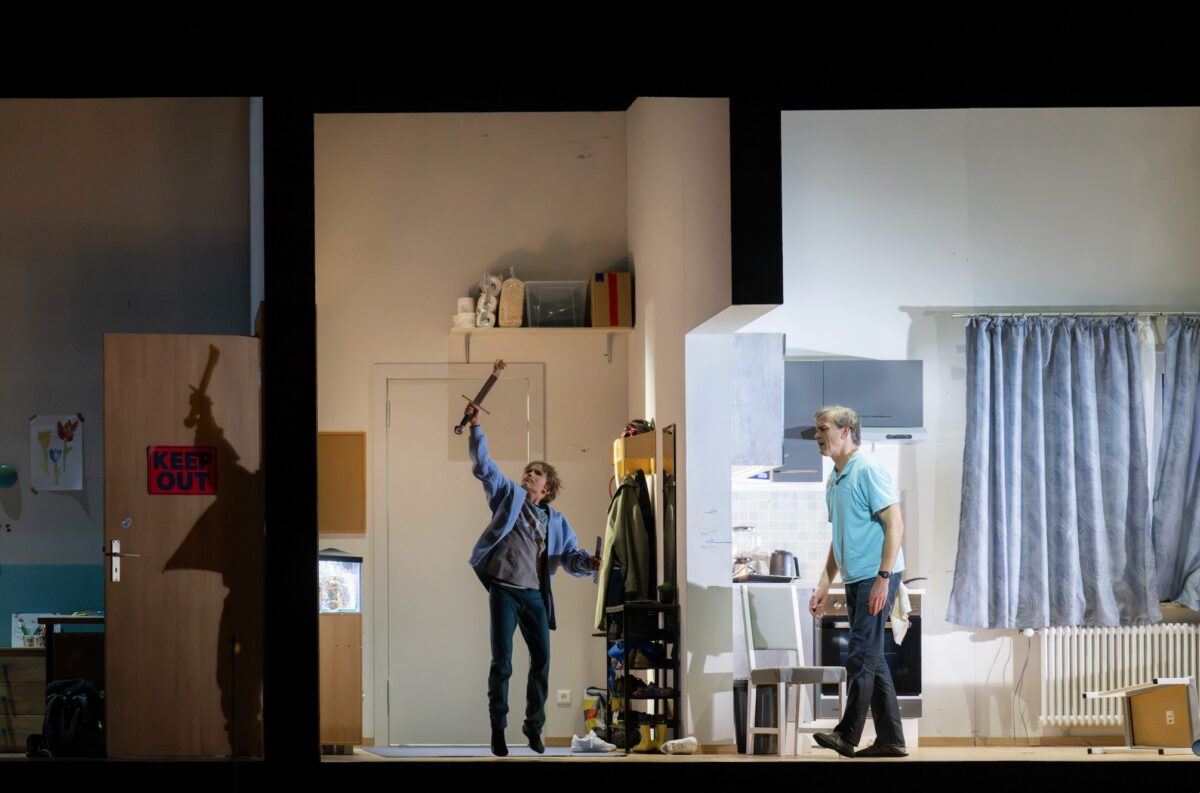
Set designs and costumes by Rainer Sellmaier blended realism with fantasy. The characters dwell in modern Germany, from Mime’s secluded condominium to Fafner’s sketchy neighborhood with a 24-hour kiosk to the dilapidated Nationaltheater in Munich (seen in Die Strollüre) the place Wotan surveils the captive Brünnhilde. Michael Bauer’s lighting assist set the magic and human worlds aside, together with ripple results for Siegfried’s communion with the Waldvogel and exploding lightbulbs destroyed by the fire-breathing dragon.
The title character is a twin position. The younger Felix Fröbel acted silently as pre-teen Siegfried in Act I, whereas Benjamin Bruns sang—rating in hand—from the facet stage. Bruns then entered the motion and helped Fröbel in the course of the forging track as a kind of imaginary buddy, taking up when Siegfried units off on his heroic journey. Bruns’s extremely anticipated position debut definitively proves he’s a greater than succesful Heldentenor, a welcome addition someplace between Andreas Schager’s sheer energy and Klaus Florian Vogt’s nimble lightness. Bruns was significantly transferring in his interactions with the Waldvogel, a candy tone that balanced tenderness and naivety.
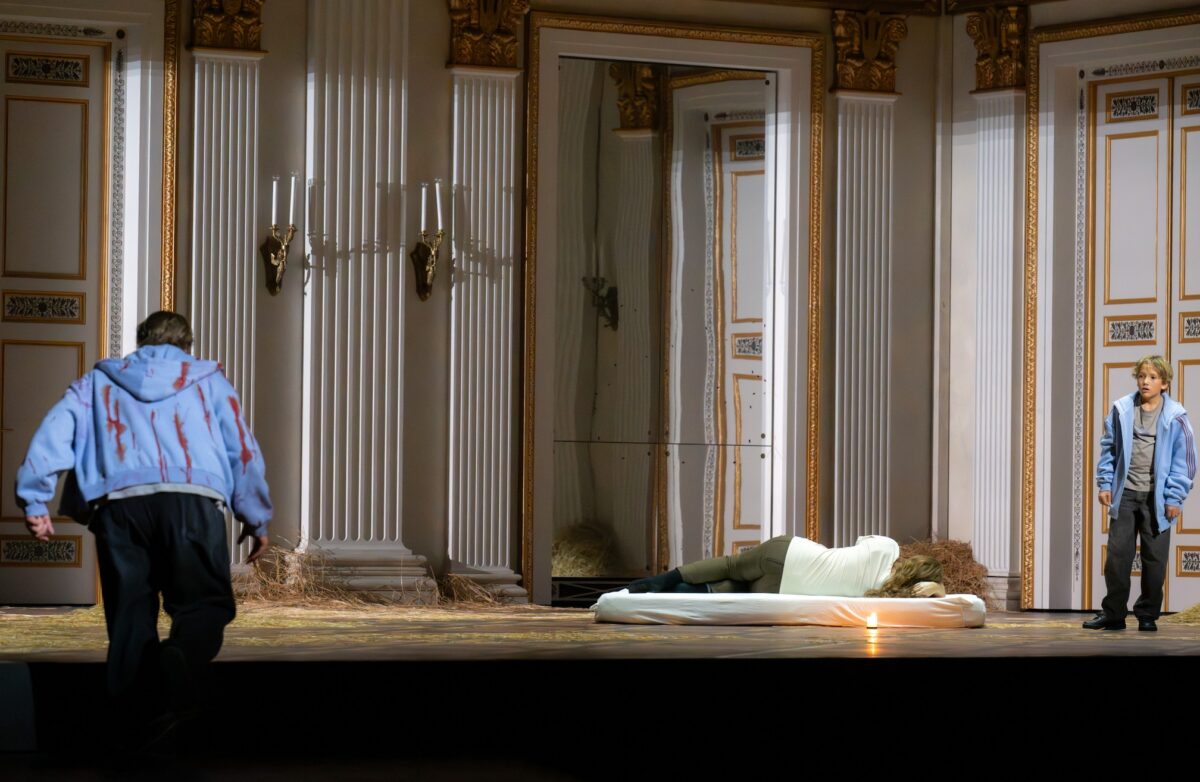
Siegfried continues to be younger and childlike on the finish of the opera. When he sees a “stunning” man sporting armor, he’s referring to himself within the mirror of the Nationaltheater’s lobby. In a hanging transfer, Fröbel then briefly reappeared when Siegfried encounters worry for the primary time. He spots Brünnhilde mendacity on a mattress with a lone small candle and mimed Bruns’s “Erwache!”
Picture: Monika Rittershaus
For Kratzer, “Siegfried’s childlike affirmation of life permits Brünnhilde to simply accept her mortality as a obligatory situation of all human pleasure.” Right here Brünnhilde’s “Heil dir, Sonne! Heil dir, Licht!” responds to Siegfried’s toy galaxy projector (first seen within the little one’s room in Act I), and the 2 relieve their anxiousness by finger portray on the corridor’s mirrors (impressed by Andi Fischer’s child-like figures featured on the theater curtain). This revisionism essentially alters the character of their relationship, but it may additionally make Siegfried’s duplicity within the subsequent installment way more plausible: Regardless of his heroic deeds, he stays a naïve little one.
Simone Schneider (taking up on this run for Miina-Liisa Värelä) was a revelation together with her excellent synergy alongside Bruns. In one other intelligent twist, her “fürchtest du nicht das wild wütende Weib?” (“do you not worry this wild, passionate maid?”) referred to not herself, however to her Valkyrie sisters who arrive protecting and skeptical of Siegfried. Schneider’s vivid higher register simply reached her excessive Cs with a heat and balanced tone.
A video projection within the Act II prelude (spectacular particular results designed by Manuel Braun, Jonas Dahl, Janic Bebi) reveals Fafner’s backstory. In Rheingold, Fafner and Fasolt have been monks who bought out to Wotan’s new faith. After the fratricide, Fafner realized he might flip again time with the ring. Biff Tannen-style, he makes use of it to build up an enormous fortune by means of sports activities betting. Having deserted his priestly duties, Fafner finds little pleasure in his new vices. He grows outdated and alone in a cramped condominium stacked with the world’s most well-known work. Timo Riihonen’s disgruntled dragon was resigned and mellow, his basso profundo unable to chop by means of Siegfried’s conscience.
Krazter additionally gives stunning depth to the Niebelung brothers Alberich and Mime by means of Personenregie and casting. Neither are merely snarling villains. In Act II, Alberich and his anarchist henchmen lurk round Fafner’s condominium constructing. In one other revision, Alberich, considerably sympathetically, sits silently subsequent to Siegfried in the course of the “forest murmurs,” they usually drink beer collectively. He has little endurance, nevertheless, for the chicken that defecates on them and shoots it down. Siegfried and his avian information rush off simply in time because the Nibelung gang return. The hero equally escapes with Brünnhilde (and Grane) as Alberich’s mob break into the theater. Georg Nigl’s method to the position had extra lieder-like smoothness than gravelly menace. His mild, lyric fach and distinctive articulation, particularly on guttural Rs, introduced Alberich a way of overconfidence slightly than overt sliminess.
Like his brother’s silent however menacing companionship, Matthias Klink’s Mime at first appears genial as a hapless foster dad or mum. He places up with infantile tantrums about his flimsy carboard swords. However this friendliness is misleading, and the exasperated Mime appears to care extra about his pets than his adopted son—memorializing his canine killed by Alberich in Das Rheingold and mourning the guinea pig “bear” which Siegfried explodes in a microwave in a nasty prank. His sloppy cooking is right here a “Wagner”-branded frozen pizza, burnt within the oven as Mime laments that “no fireplace of mine can ever fuse” the actual sword. Whereas Klink’s decrease register lacked some depth, bodily at its limits by the tip, he made up for it with beautifully dynamic appearing to point out this two-facedness.
The Waldvögel that guides Siegfried is a mechanical chicken, injured by Alberich’s gun. Per Wagner’s directions, it’s sung by a boy, right here offstage by Leo Eisenreich of the Tölzer Knabenchor (the identical boy choir used to nice impact within the HIP Siegfried in Dresden). Eisenreich was sadly tough to listen to as a result of distance, however given the dramaturgy, his damaged phrasing made sense for the injured chicken.
Picture: Monika Rittershaus
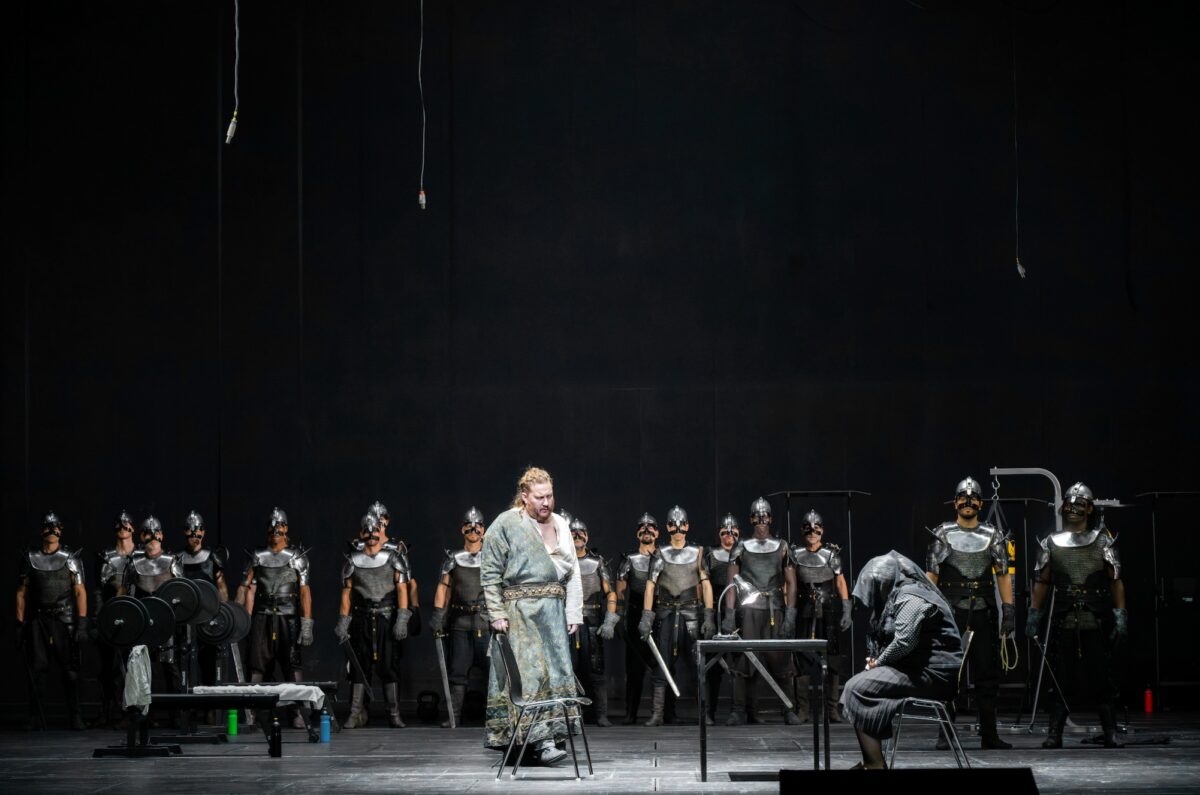
In Kratzer’s imaginative and prescient, the Wanderer is a Wotan nonetheless agile however more and more weary of his energy. He enters in skinny disguise (as Mime prepares to take out the trash) and palms the sleeping Siegfried a golden apple (which he promptly dumps within the trash). Nicholas Brownlee inhabits the position with growing nuance and even clearer diction for the reason that final two installments. His voice is powerfully uncooked at moments, however nonetheless very refined in articulation and tone. Already an outstanding storyteller in Die Walküre’s Act II monologue, right here we noticed Brownlee inhabit Wotan’s full psychological breakdown after interrogating Erda and unsuccessfully blocking Siegfried’s path.
The scene, set within the gym-like backstage of the Nationaltheater stuffed with undead Valhalla warriors, underscores Wotan’s determined clinging to energy. Erda, against this, receives Wotan’s fury with poise. Wiebke Lehmkuhl delivered Erda’s recommendation at a measured tempo with a vivid tone.
Music Director Vladimir Jurowski and Bayerische Staatsorchester have been at house with the rating. Jurowski has famous how Wagner’s avant-garde colours and textures in Act I impressed Humperdinck’s witch in Hansel and Gretel and Stravinsky’s Kashchei in The Firebird. With Act III, composed twelve years later, Wagner innovated additional. Jurowski emphasised these forward-thinking particulars with much more power and quantity than the primary two Ring installments, particularly relishing the galloping end to Act I and the slender, spooky distinction to start out Act II. The orchestra’s depth sometimes got here on the expense of the singers, overlaying Klink and Nigl in softer passages.
Indicators level to an apocalyptic imaginative and prescient for the ultimate installment. In Das Rheingold, Alberich graffitied church buildings with Nietzsche’s “God is lifeless” whereas converts have been seduced by the brand new pagan golden altarpiece, staring agape Chereau-style. Now in Siegfried, a person on the road holds up a cardboard signal studying “the tip of the world is nigh, solely Wotan can save us.” Wotan has clearly failed along with his military of Valhalla troopers, and childlike Siegfried has already bonded with Alberich, organising the right storm. Audiences subsequent summer time are in for a chaotic remaining showdown.

