


Photograph: Roberto Ricci
When Voltaire offered the Enlightenment drama Alzire, ou les Américains in Paris in 1736, he set in classically elegant alexandrine verse a few of the politically tragic implications of Europe’s conquest of the indigenous peoples of America, represented by the rivalry between an Incan warrior and a Spanish conquistador for a similar Peruvian girl. When Verdi took up the topic in Naples in 1845, within the spirit of operatic Romanticism, the peoples of Latin America had largely achieved independence within the revolutions impressed by Simón Bolívar in the course of the 1820s, and the ability of empires now not appeared invincible; topic peoples now not appeared hopelessly subjugated, and the wrestle between the tenor Zamoro and the baritone Gusmano for the soprano Alzira was already formed by a way of contemporary nineteenth-century nationwide antagonism. Although a success for Voltaire, Alzira was one in every of Verdi’s least profitable and, at the moment nonetheless, one in every of his most uncared for works. The brand new manufacturing on the Parma Verdi Pageant this fall, performed by James Conlon, made the case for this opera as a piece that any Verdian would need to know, together with his early genius on full show in a collection of thrilling arias and particularly within the magnificent ensemble finales of each acts.
The theme of the Parma competition this yr was “mondi lontani” (distant worlds), and the operas all had settings exterior Europe: Alzira in colonial Peru and Nabucco in historical Babylon, each carried out within the Parma Teatro Regio, and Aida in Previous Kingdom Egypt carried out in a miniature manufacturing in Verdi’s hometown Busseto. Moreover, Conlon provided a gala live performance on Verdi’s birthday, October 10, that included live performance performances of the second act of Il Corsaro and the third act of Jérusalem. Each operas are not often carried out, and every of these acts presents a Christian assault on the Muslim world (particularly, its harems) within the Ottoman Mediterranean (Il Corsaro) and the Holy Land of the Crusades (Jérusalem).
Verdi’s imagined geography of the broader world was not, on the entire, about inventing idioms of musical exoticism, like the sooner alla turca fashion of Mozart’s Abduction within the 1780s or the later pentatonic “Chinese language” elements of Puccini’s Turandot within the Nineteen Twenties. Verdi’s Babylonian and Egyptian characters are likely to sing very very similar to his European characters, as do the Peruvians of Alzira. In truth, the politics of Verdian opera within the 1840s, the age of the “Giovine Italia” (Younger Italy) motion for Italian unification and independence, meant that the choruses of Hebrews in Nabucco, of Scots in Macbeth, and likewise of Peruvians in Alzira, partly channeled the nationwide sentiments of the Italian Risorgimento, aiming to emancipate these Italian provinces dominated by the Habsburg emperor in Vienna. The Verdi opera whose dramatic construction stands closest to Alzira of 1845 is Ernani of 1844, with the identical rivalry between tenor and baritone for the soprano, with the tenor a political insurgent towards the imperial energy of the baritone. In Ernani, the baritone is none aside from the Habsburg Emperor Charles V, additionally king of Spain, whereas in Alzira the baritone is presumably the Spanish consultant of Charles V in Peru. Verdi’s lifelong political antagonism and ambivalence towards the historic and up to date Habsburgs (assume Don Carlos) formed his operatic conception even of “distant worlds” and made the Peruvians of Alzira into honorary Italians combating for his or her homeland.
Following an overture that concludes in a army marching rhythm, allegro brillante, fortissimo, the curtain rises on a prologue through which the male refrain of Peruvians have taken an unlucky Spanish prisoner. A short orchestral introduction begins pianississimo (ppp), with an ensuing crescendo that lastly has the refrain getting into explosively on the phrases “Muoia, muoia” (let him die) as they put together to execute their captive. Propelled ahead in 6/8 time, the rating is marked “tutti con accenti ferocissimo,” in order that the accents fall with percussive ferocity, two to a measure, on each syllables of “muoia.” The libretto (by the Neapolitan Salvadore Cammarano) has the refrain calling savagely for “il tormento di mille tormenti,” the dying of a thousand cuts. In truth, ferocity is the dominant spirit of this rating, on either side of the army encounter, and a few Verdians would possibly want for extra pathos and extra expansive lyrical moments in an opera that provides comparatively little reduction to the emotional depth of the wrestle throughout a concentrated ninety minutes of music, Verdi’s shortest opera. That stated, the music is hardly unvarying, and the refrain of “Muoia muoia” is out of the blue remodeled by a shift from G-minor to G-major and the introduction of a wholly new sentimental spirit, “O fratelli, caduti pugnando/ dalle tombe sorgete ululando,” (O brothers, who’ve fallen in combating, rise lamenting out of your tombs), set to a rolling melody over triplet accompaniment, nonetheless in 6/8 time. The refrain of the Teatro Regio made this shift of key and spirit into one thing magical, below Conlon’s baton and the choral path of Martino Faggiani, because the Peruvians name on their fallen brothers to affix them from the grave in a hymn of triumph, the form of hymn that Italians, together with Verdi, would compose for their very own nationwide Risorgimento.
The Peruvian tenor hero of the opera, Zamoro, sung with heroic tone and stirring fervor by Antonio Poli, makes his first dramatic look within the prologue to demand that his fellow Incans launch the prisoner who’s about to die the dying of a thousand torments. “Return to your individual individuals, previous man,” he declaims, “and inform those that name us savages {that a} savage gave you your life.” Like Voltaire, Verdi and Cammarano have been within the query of who the true “savages” have been within the Spanish colonial encounter with the Incas. The previous man will transform Alvaro, the Spanish governor and the daddy of Zamoro’s enemy and rival, Gusmano.
Photograph: Roberto Ricci
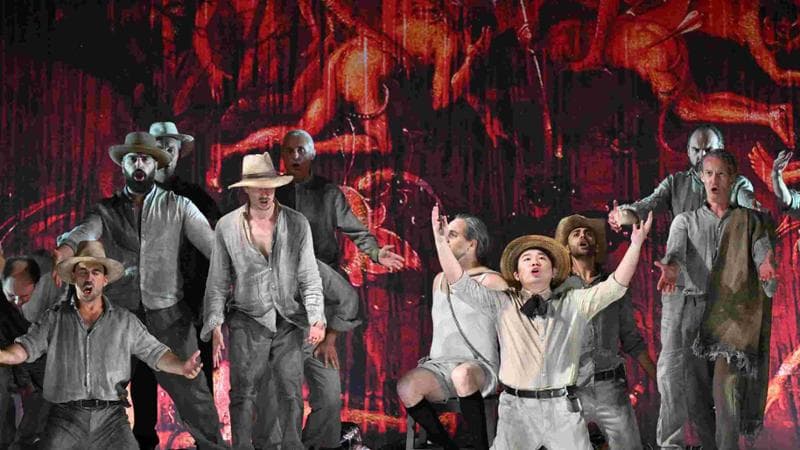
Zamoro’s opening aria, in syncopated ¾ time, sung over lyrical triplets, recollects his personal merciless imprisonment by the Spaniards, when his spirit was sustained by love for Alzira. When he now learns that Alzira is herself a prisoner in Lima, he leads the male Peruvian refrain in a fierce martial cabaletta, invoking the “Dio della guerra,” the Incan god of warfare, Poli magnificent right here with ringing prime notes and heroic coloring. The refrain is keen to struggle and the rating notes that “all of them embrace each other with flashing eyes and savage exultation.” These Peruvians, in Manuel Renga’s manufacturing, should not costumed as feathered primitives however reasonably as trendy campesinos in Andean cowboy hats, in order that Zamoro would possibly seem as a Latin American chief within the era of Bolívar within the nineteenth century, or Che Guevara within the twentieth century, and even the Peruvian Shining Path. Zamoro was Verdi’s very subsequent tenor function after the outlaw Ernani however already pointed towards the Roma hero Manrico of the subsequent decade, all of those elements already in Poli’s repertory. Most curiously, Zamoro might be seen as a form of first iteration of the Incan tenor function of Don Alvaro in La Forza del Destino— think about Zamoro crossing the ocean and falling in love with a Spanish noblewoman— and contemplating Forza alongside Alzira maybe permits us a clearer sense of how Verdi contemplated Don Alvaro’s Incan identification.
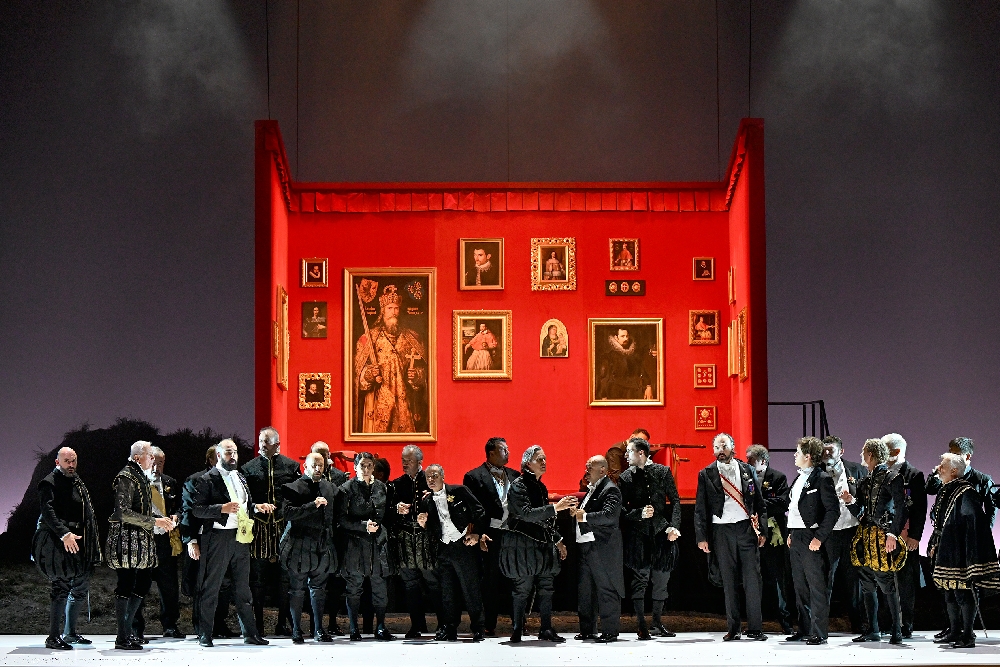
The baritone function of Zamoro’s Spanish nemesis Gusmano is maybe extra musically advanced, and his unreciprocated love for Alzira provides a component of highly effective longing to his music. Florida-born Spanish-American baritone Daniel Luis de Vicente was an enormous success on this function with excellent Verdian phrasing and darkly lovely colorings. He sang his first aria of infatuation for Alzira whereas rising from a gallery hung with sixteenth-century work of popes, cardinals, and princes, permitting him to bridge the areas of colonial conquest and up to date battle. Maria Torbidoni sang the title function of Alzira with all its bel canto ornamentation, torn between her love for Zamoro and her father’s diplomatic endorsement of a Spanish marriage to Gusmano. She and Poli harmonized passionately of their love duet, solely to be interrupted by the arrival of Gusmano in a frenzy to arrest and destroy his rival.
Photograph: Roberto Ricci
Zamoro denounces him with Cavaradossian contempt—carnefice!—establishing the first-act finale ensemble which begins with Alvaro and Gusmano, father and son, bass and baritone, contesting Zamoro’s destiny (for it was Zamoro the savage who gave Alvaro his life within the prologue). “Trema trema!” sings Gusmano, making an attempt to terrorize the lovers who reply unintimidated. Along with her voice rising above all the firm, Torbidoni ascended chromatically with sustained notes on excessive G, G-sharp, A, A-sharp, after which threw herself right into a collection of stirring excessive Bs of soprano defiance. Conlon superbly introduced collectively all of the vocal elements and orchestral forces that make this first-act finale a Verdian masterpiece.
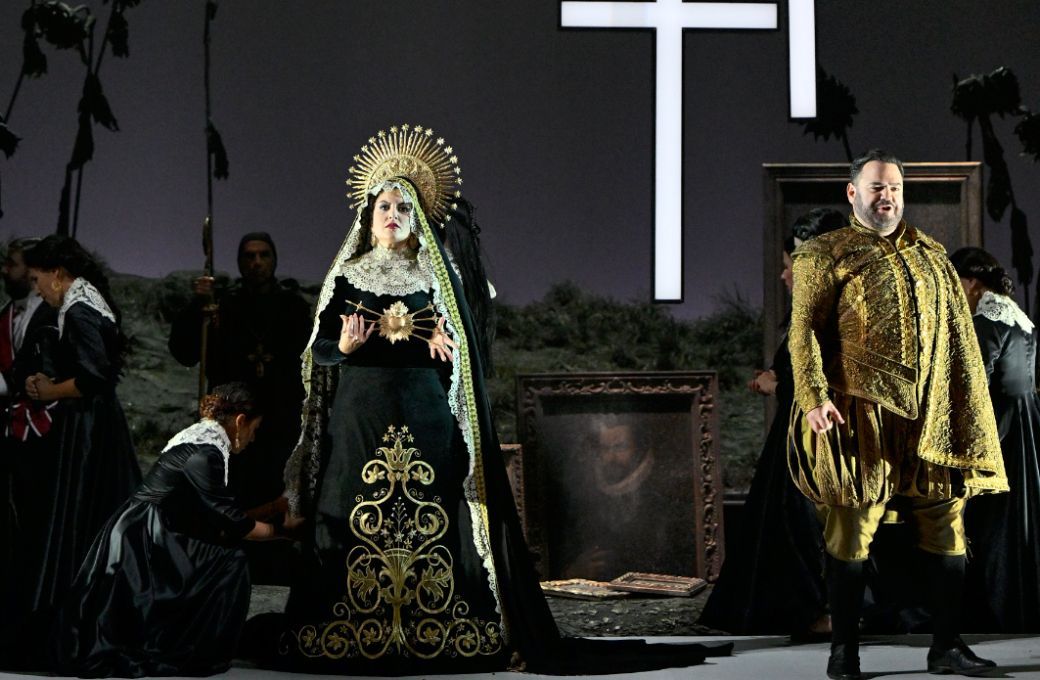
Radically totally different was the marvelous finale of the final act, this time with Zamoro showing simply in time to homicide Gusmano earlier than he can marry Alzira, robed for her marriage ceremony just like the Holy Virgin in Latin American folks artwork. Cammerano was the librettist for Donizetti’s Lucia di Lammermoor in 1835, so the interrupted marriage ceremony was one in every of his logos, and the unique Zamoro, Pavian tenor Gaetano Fraschini, was probably the most well-known Edgardo of the period, completely ready for the function of the marriage crasher in Alzira. The dying Gusmano, nonetheless, unexpectedly forgives his assassin and blesses the Peruvian lovers over harp arpeggios, discovering the baritone pathos of the conquistador, not heartless in any case. The reconciliation will not be fully convincing however a musical event of nice Verdian magnificence and trustworthy to Voltaire, who had additionally imagined this conclusion of reconciliation—an nearly counterfactual conclusion since, in fact, the Spanish imperial conquest and domination of Latin America did actually happen. For Verdi, as within the later composition of the dying of Simon Boccanegra, it was maybe a second for fantasizing that the dying of a repentantly magnanimous baritone would possibly provide a second of peace and reconciliation in a world of violence and warfare. On this regard, it’s price taking a look at thinker Martha Nussbaum’s new e book: The Republic of Love: Opera and Political Freedom (2026), principally about Mozart, but additionally contemplating Verdi.
De Vicente returned within the Verdi Gala on October 10, Verdi’s birthday, taking part in two unrepentant roles. First, in Il Corsaro he was the Muslim Pasha Seid whose harem is the setting of the second act, and with richly highly effective tone he invoked “Allah vincitor,” resisting the Christian assault. De Vicente was equally implacable because the Christian crusader Rely of Toulouse, condemning to dying the knight Gaston on a false cost of tried homicide, within the third act of Jérusalem. But the standout stars of the birthday gala have been the Mexican-American tenor Galeano Salas and the younger Italian soprano Alessia Panza as a harem captive in each operas, Gulnara and Hélène in Corsaro and Jérusalem respectively. Panza sang gorgeously of her plight with a richly full tone that stuffed the Teatro Regio, displaying a beautiful trill in Gulnara’s cabaletta and hovering above the refrain as Hélène denounced her father for condemning her lover Gaston to dying.
Salas was the Byronic corsair who tried to rescue Gulnara in Corsaro, after which took the function of the falsely accused Gaston in Jérusalem, the French model of I Lombardi, reconceived by Verdi for Paris in 1847. Singing with elegant French phrasing and plaintively reedy tenorial tone, Salas, following Conlon intently within the pit and accompanied onstage by a Latin refrain of crusading knights, carried out probably the most lovely Verdi scene that you just’ve by no means heard— until you realize Jérusalem. It’s the judgment scene of a person condemned to dying protesting his innocence, not in anger however with deepest pathos. The main tenor function in I Lombardi (1843) was, unusually, a Muslim prince, Oronte, who received the love of the Christian harem captive, nearly unprecedented within the Muslim-Christian dynamics of operatic historical past. Verdi, nonetheless, eradicated the Muslim prince when he remade I Lombardi as Jérusalem, and simply because the Lombards turned Frenchmen, so Oronte turned the Frenchman Gaston, legally topic to condemnation by the French crusaders. The judgment scene merely didn’t exist in I Lombardi (as Gaston didn’t exist) and was composed as one thing fully new for Paris, for a tenor on trial, not stoically silent like Radames earlier than his judges in Aida, however heartbreakingly lovely because the wrongly accused man lamenting the cruelty of the destiny inflicted upon him by his personal individuals in a distant international land.
Verdi was at residence in European opera capitals from Naples to Paris, and even traveled so far as St. Petersburg (for the premiere of La Forza del Destino) however didn’t go to Cairo (for the premiere of Aida). He was all the time most at residence at his villa of Sant’Agata, close to Busseto, within the province of Parma. Although he by no means left Europe, his operatic eventualities ranged extra broadly, and his genius dropped at life the characters of distant worlds, characters whose human feelings, for Verdi as for Voltaire, have been usually universally recognizable. The not-so-savage Peruvians of Alzira appeared altogether at residence within the elegant Parma Teatro Regio, the place the Parma Verdi Pageant continues to discover even probably the most not often staged scores and eventualities of Verdi’s distant and acquainted worlds.

